-
Ruiz-Healy Art is pleased to present Paper Trails, concurrent group exhibitions of works. Featured artists at our San Antonio gallery include Carlos Almaraz, Nate Cassie, Nicolas Leiva, Constance Lowe, Jennifer Agricola Mojica, Daniela Oliver Portillo, and Ethel Shipton. Featured artists at our New York gallery include Santa Barraza, Cecilia Biagini, Francisco Toledo, Ruben Leyva, Celia Álvarez Muñoz, Cruz Ortiz, and Rufino Tamayo. Paper Trails explores distinct processes that use paper as a primary substrate, including painting, printmaking, experimental drawing, and mixed-media works. These procedures offer intimacy and insight into an artist’s diverse techniques, revealing their processes, aesthetic experimentation, and operations.
-
SAN ANTONIO
-
-
 Constance LoweDrift Threshold #1 (Afloat/Aground), 2021Archival inkjet prints with wool felt and leather16 x 13 in
43.2 x 35.6 cm -
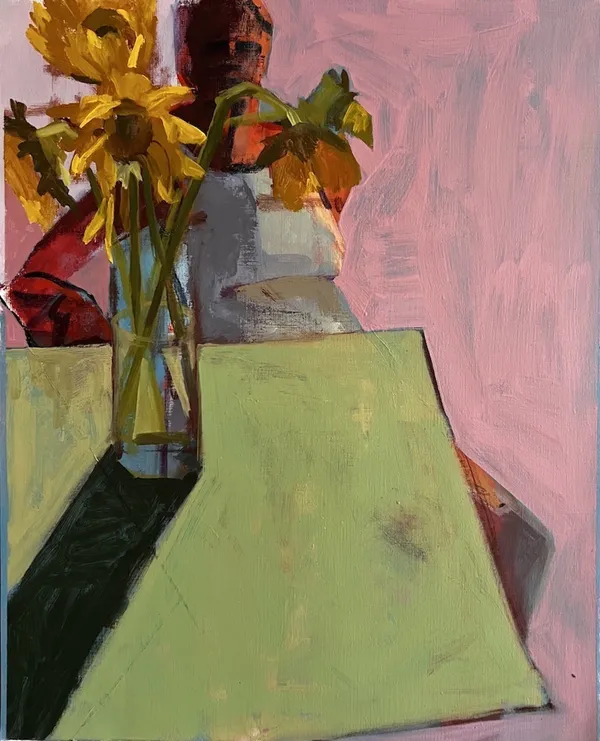
Jennifer Agricola Mojica’s work explores themes of transience, time, and fragility as a way to digest personal experiences and larger societal issues. Tranquil colors come together to form flowers, overhanging, and sitting fruit. Mojica thematically explores rest and maternal instinct, invoking a subtle feminine presence in the gentle flowers.
-
-
-
Oliver de Portillo’s thematic exploration focuses on the dualities of domestic life, with flowers symbolizing this experience. She reflects on the paradoxes women face, contradictions of identity and societal expectations, and modern womanhood depicted through the flowers that adorn the home. Oliver de Portillo is a multidisciplinary artist based in San Antonio, TX. Her titles are always presented in both Spanish and English, acknowledging her dual identity.
-
-
Nate CassieThe mountain as it is (Mauna Kea drawn from life July 5, 2021), 2021Signed on the reverse. dated in the front upper rightGraphite on paper10 x 16.25 x 1.5 in
25.4 x 41.4 x 3.8 cm -
Nate CassieThe mountain as it was (Hualalai drawn from a photograph taken on July 1, 2021), 2021Signed on the reverseMixed media on paper14 x 21 x 1.5 x 1.5 in (frame size)
36.3 x 54.1 x 3.8 cm
-
-
Nicolas Leiva’s vessels, boats, abstract forms, and flying carriages transform into playful charcoal illustrations. His imaginative world unfolds in infinite realms like a Möbius strip. Leiva’s works are fantastical landscapes that utilize gestural, organic, and geometric forms to present a host of archetypes in his emblems of flight, safety, and delight.
-
Nicolás LeivaLas 3 Lunas, 2013Charcoal on Paper24.75 x 39 in
62.9 x 99.1 cm -
-
Joel SalcidoAtotonilco El Alto, 2012Signed lower right, numbered lower leftArchival Pigment ink print on cotton fiber paper29 x 41 in
73.7 x 104.1 cmEdition of 6 plus 1 artist's proof(Edition record) -
Castro PrietoBahía de Cook, Isla Tanna. Vanuatu, 2005Signed and dated on the reverseMineral pigments inkjet on 100% cotton paper23.6 x 19.8 in
59.9 x 50.3 cmControl de copia 3(Edition record)
-
-
The photograph Atotonilco el Alto, an iconic landscape from Salcido's series, Aliento A Tequila, gained broader recognition after being featured in the December 2013 issue of Texas Monthly. This image captures the beautiful landscape outside Tequila, Jalisco, Mexico. Similarly, Prieto's work is characterized by a highly personal, serene, and solitary tonality. Childhood is a frequent focus in his oeuvre, and here he captures a quieter moment: a child engaged in solitary fishing on a calm, bright blue bay.
-
-
-
Andrés Ferrandis’ constructions of objects and collages on paper utilize photography, fragments of text, and cut-paper organic and geometric forms that seem to drift and swirl through landscapes of memory. Varied in their materials, the works also introduce another hybridity: elements are echoed in the compositions that bridge Ferrandis’ painting history with his design practice in collages and architecture.
-
-
-
Born in Mexico City in 1941, Carlos Almaraz became a prominent artistic figure in the Chicano Movement of 1970s Los Angeles. A founding member of Los Four, one of the earliest Chicano art collectives, Almaraz spent much of his early career engaged with social and activist art, collaborating on murals, banners, and posters in direct support of El Movimiento. By the late 1970s, however, Almaraz transitioned from primarily public projects to incorporating more private studio work with an introspective lens.
-
-
Rufino TamayoHombre con Sombrero, 1976Signed lower right, editioned lower leftLithograph on Arches paper. Taller de Gráfica Mexicana, Ciudad de México29.5 x 22.5 in
74.9 x 57.1 cmEdition 47 of 100(Edition record) -
Francisco ToledoPez, 1981Signed lower left, editioned lower rightMixografia print on Arches & handmade paper19 x 22 in
48.3 x 55.9 cmEdition 85 of 100(Edition record)
-
-
Rufino Tamayo experimented with shape and composition in his fractured, schematic, and abstract portraiture. Adroitly synthesizing influences from Mexican and international sources, including Cubism and Surrealism, Tamayo conceived life and art as a universal heartbeat. Simaltenously, Fransisco Toledo
worked closely with the Taller de Grafica Popular atelier, now known as Mixografia, to create prints with enhanced dimensionality and texture, departing from traditional printmaking methods. The technique allows artists to incorporate elements of relief and fine surface detail into prints by using wet handmade paper.
-
Drawing on a deep familiarity with the Western art canon, Martínez's work finds inspiration in diverse sources, including color-field paintings, Mexican architecture, landscapes, and photography. Ixta y Popo exemplifies this by placing a bleeding heart at the center, set against Popocatépetl—one of Mexico's most active volcanoes. Both Enriquez and Martinez draw on experiences of the borderlands. Drawing inspiration from his early life in El Paso's historic El Segundo Barrio, Gaspar Enriquez is known for his powerful portraits of Chicano/a individuals. His subjects often include artists, charros, and everyday people from the barrio.
-
New York
-
-
Rufino TamayoDeux têtes, Mujeres suite, 1969Color lithograph, Atelier Desjobert, Paris29.50 x 22 in
73.7 x 55.9 cmEdition XXIII / XXV (23 of 25) -
Ruben LeyvaAves, 1992Pastel and mixed media on paper22 x 29.5 in
55.9 x 74.9 cm -
Mujer Lagartija and Changos showcase Toledo’s technical strengths as a draughtsman. Throughout his prolific career, he often turned towards representations of the natural world as meditations on the human experience. In dense and dynamic compositions, figures with abstracted zoomorphic traits engage in activities ranging from erotic pleasure, childbirth and rearing, to even fishing (despite their piscine appearances). For Toledo, these investigations into cross-species transfiguration are not mere shock or play but serious considerations of human traits and social structures.
-
Santa BarrazaMujeres Nobles Series: Frida con Tezcatlipoca y Coyolxauhqui, 2015Acrylic on amate paper23 x 15 in
58.4 x 38.1 cm -
Cruz Ortiz, with his bright, lively, fractured portraiture, uses works on paper for historical preservation and documentation. Ortiz’s Nuevo Tejas (New Texas) aesthetic incorporates Spanglish text, abstract figures, and dreamlike scenery, indulging in the playfulness of Chicano culture to portray the distinct sensibilities of Tejano communities. Central to this practice is Ortiz’s notable deployment of language: the artist’s use of both Spanish and English does not simply nod towards bilingualism, but rather asserts the blending of the two languages as integral to defining Mexican American identity in and of itself.
-
Celia Álvarez MuñozSweet Nothings, 1998Photoetching and silkscreen, Flatbed Press, Austin, TX19.5 x 26 in
49.5 x 66 cmEdition of 50 -
-
-
Influenced by the legacy of abstraction in 20th-century Latin American art, Argentine artist Cecilia Biagini examines the formal qualities of abstraction, with a particular emphasis on color and line, as she moves across media. In her “Untitled” sewing machine drawings, Biagini blurs distinctions between textiles and drafting, resulting in works that range from rigidly structured to playful and improvisational. Subversion of medium and genre is integral to Biagini’s work, the effect of which, as noted by the poet Cecilia Pavón, is “as if the cerebral impersonality of geometry had only been a tool in service of the invention of new and unknown sensations.” In the artist’s words, “Sewing machine drawings were among the first works I made in Brooklyn, NY, after arriving from Buenos Aires. They have a topographic quality, flowing across the paper’s surface, rushing forward, with the machine guiding the movement. They move randomly and embrace accidents along the way.”
Paper Trails: San Antonio & New York
Current viewing_room