-
Ruiz-Healy Art is pleased to present 20 Years: Ruiz-Healy Art, a group exhibition of 20 artists represented by the gallery, celebrating its two decades in San Antonio. The exhibition will feature works by Pedro Diego Alvarado-Rivera, Jesse Amado, Richard 'Ricky' Armendariz, Cecilia Biagini, Mel Casas, Nate Cassie, Jennifer Ling Datchuk, Alejandro Diaz, Graciela Iturbide, Consuelo Jimenez Underwood, Leigh Anne Lester, Nicolás Leiva, Constance Lowe, César A. Martínez, Celia Álvarez Muñoz, Cecilia Paredes, Eva Marengo Sanchez, Ethel Shipton, Chuck Ramirez, and Frank Romero.
-
-
 Pedro Diego Alvarado-RiveraAgaves de Tequila, 2026Oil on linen27.25 x 43.25 in
69 x 110 cm -
Cecilia BiaginiÁnimas, 2024Acrylic on canvas67 x 64 in
170.2 x 162.6 cm -
-
-
Leiva’s work explores life, transformation, and spirituality through vibrant ceramics that blend natural and cultural influences. Inspired by his father’s role as founder and director of a nature reserve in Argentina, Nicolás Leiva creates fantastical ecosystems where flora and fauna merge into imaginative ceramic figures. Leiva’s creations also reflect the decadence of Italian art, with its beauty and craftsmanship. Just as pollinators sustain life, Leiva metaphorically draws on his diverse influences to create works that bridge the corporeal and the mystical.
-
Cecilia ParedesMapa Mundi, 2024Printed imagery on Hahnemühle acid-free paper32 x 43 in
81.3 x 109.2 cmEdition of 7Mapi Mundi is part of the Celestial series that Cecilia Paredes began in 2017. Drawing on a wide range of references, including astrological drawings, Mesoamerican codices, and European cartography, Paredes says she spent years “studying in the archives of the Library of Congress about early maps, manuscripts, the discovery, cosmology, visions, and myth.” Reminiscent of early European documents about the “new” world, which consistently characterized the pre-colonial landscape as magical, exotic, and dangerous, Paredes subverts these notions through her array of subject matter, reminding viewers, in the artist’s words, of “how small we are in the universe.”
-
Graciela Iturbide is regarded for her cinematic black and white photographs depicting indigenous groups and settings in her native Mexico. The subtle yet powerful photographs blend the essence of the cultures from her native Mexico with her own personal vision and love of poetry. Her pictures combine the story of a culture in transition with issues of identity, diversity, and selfhood. Drawn to women’s rituals and roles in marginalized societies, Iturbide focuses on experiences that are too often ignored by the mainstream media and art world.
-
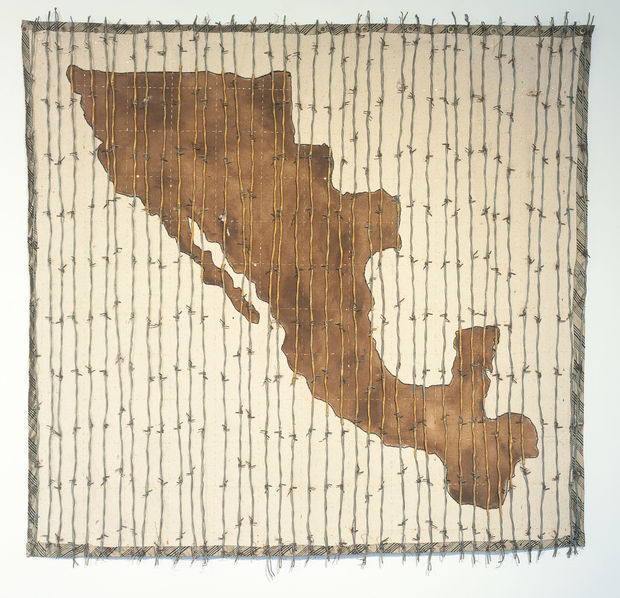
Consuelo Jimenez UnderwoodMi Oro, Tu Amor, 1994Textile paint, wrapped, embroidered, stitched on canvas. Silk fabric, barbed wire, gold wire, paint, corn, and bean kernels48 x 51 in
121.9 x 129.5 cm -
Celia Álvarez Muñoz’s Petrocuatl comes from a parafictional talk she gave as a Master of Fine Arts student, in which she presented the supposed archaeological discovery of a new ancient Aztec deity named Petrocuatl, dubbed the god of gasoline. In the first print, Muñoz brings this fictional deity to life through a gas mask adorned with colorful feathers. Set against a bright pink backdrop, the mask’s feathered adornments are reminiscent of a penacho (a ceremonial headdress of the Nahua people), with jewelry to match. In the second, Muñoz recreates a page from National Geographic, Vol. 158, No. 6, December 1980, published only two years after the Templo Mayor was discovered during routine infrastructure upgrades. The image depicts an aerial view of Mexico City with a phantasmic Aztec pyramid appearing where it might stand today, had it not been destroyed during colonization efforts. Both works are printed on Cibachrome, a now-defunct process, which gives them an unusually high brilliance.
-
César A. MartínezRed Bato, 2026Acrylic on paper30 x 22.375 in
76.2 x 56.8 cm -
Bolivia gets its name from the textile in the work: an early-twentieth-century Bolivian aguayo weaving, a motif the artist includes in many of the still lifes in this series, which began in the 1980s. In the painting, we also see a large sculpture by the artist, one of his classic painted wood Carro con Corazones, alongside a Tang dynasty Chinese porcelain horse, one of the countless objects that Romero has acquired over the years and keeps as props in his studio. Their inclusion alludes to both his collecting tendencies and the cultural intersectionality of East L.A.
Romero’s interest in cowboy culture began in childhood, when he and his younger brother shared a love of classic Western cinema. For Romero, Western films evoke memories of the 1950s, when he watched shows like Buffalo Bill Cody and Howdy Doody with his neighbors. -
-
-
Mel Casas began creating smaller-sized works after his retirement from academia and his professorship at the San Antonio College in the early 1990s. Although officially retired, Casas used his newfound time and freedom to broaden his subject matter. “The only difference is, my agenda now is my own, instead of just working for schools and other duties,” Casas said in a 1996 interview with Paul Karlstrom. As opposed to his sprawling narrative Humanscapes, the smaller format shows an intimate study of compositional freedom. He delves into various colors, forms, and subject matter in his work, creating scenes that are representative of the full scope of his oeuvre.
-
Richard 'Ricky' ArmendarizThe Musicians of Bremen (Si Se Puede), 2026Woodblock Print
Hare & Hound Press, San Antonio, TX38 x 50 in
96.5 x 127 cmEdition of 10The Musicians of Bremen (Si Se Puede) references the Brothers Grimm’s classic German fairy tale. Instead of reproducing its original cast—a donkey, a dog, a cat, and a rooster—Armendariz incorporates flora and fauna native to the landscape where he grew up along the U.S.–Mexico border. Like the original tale, in which four animals their owners consider no longer useful band together in search of a better life, the work shows a variety of animals cooperating as they toil. Through Armendariz’s lens, the composition reimagines the German tale and highlights collective resilience.
-
Chuck RamirezDust Collections and other Tchotchke: White and Red Hen (diptych), 1995, 2026Pigment inkjet print on cotton watercolor paper14 x 12 in (each)
35.6 x 30.5 cm (each)Edition of 10 -
Chuck RamirezLost and Found: Buddha, 2008Pigment inkjet print, edition of 3 and 6 respectively40 x 32 in, 101.6 x 81.3 cm
or 20 x 16 in, 50.8 x 40.6 cm -
Specializing in the modern-day still life, Eva Marengo Sanchez utilizes everyday objects in her work to elevate the commonplace, creating new iconic symbols through her bicultural and Tex-Mex lens. Born in San Antonio in 1990 and currently living there, Sanchez's connection to the city is clear in her work through her representation of local food, identity, geography, and culture. Reminiscent of early 17th-century floral oil paintings, Eva replaces the traditional vase with a salvaged oregano jar and a Spurs cup. Recurrent in Eva's work, the theme of replacing the mundane with locally salient objects transforms everyday imagery into personal and cultural symbols.,
-
Born in San Antonio and now living in New York City, Alejandro Diaz creates a series of paintings that picture three different places in a similar manner. Diaz uses everyday imagery, humor, and pointed cultural commentary to represent the layered visual culture of Texas, Spain, and Mexico. The works use a shared structure: a flat, saturated sky paired with a low, dark horizon, finished with one emblematic object. In Texas, an oil pumpjack stands beneath a heavy yellow sun; in Spain and Mexico, the pumpjack gives way to a soccer goal, a symbol of sport, competition, and national pride the two countries share. Seen side by side, the works invite comparison, showing how simple places and symbols can hold a culture's aspirations and limits.
-
Jesse AmadoA Holy Groast, 2023Acrylic and mixed media on wood11 x 12 x 2 in
27.9 x 30.5 x 5.1 cm -
Drawing on the ancient theory of the four humors, Humoral Vessels: Choleric (fire) explores links between the body, temperament, and nature. Rooted in Ayurvedic traditions and developed through Greek, Roman, and Islamic medicine, humoral theory shaped ideas of health for centuries. It held that each person’s unique balance of humors shaped their personality, appearance, behavior, and relationship with the environment. Each humor corresponded to a temperament and classical element: choleric (fire) signified passion and ambition.
Inspired by traditional Buddhist imagery and the personal experience of watching a lover at rest, Cassie explores the relationship among life, transience, and transcendence. Parinirvana is the final nirvana a Buddha attains at death, signifying complete release from samsara (wandering) and the end of the cycle of rebirth. While traditional depictions of Parinirvana feature a reclining figure surrounded by disciples and a landscape reminiscent of the curved body, Cassie instead offers an intimate exploration of the landscape itself.
-
These porcelain baby forms are cast from an antique Chinese export ware ceramic pillow form-made to prop up the head and protect hairstyles during sleep. An uncomfortable form of labor meant to uphold the façade of wealth and status. I remade them to carry the weight of Asian women's labor, and they seem to wear expressions of delight on their faces, while in a tabletop position, carrying things on their backs-a nod to how Asian women experience fetishization while also laboring and providing service, product, or resource. The objects they carry-peaches, oranges, blue-and-white porcelain vessels, peach pits, and sewing thimbles-represent longevity, luck, and beauty, and symbolize the labor they embody and the comfort and care they provide to others, even as they often go without.
-
Constance LoweBluebird Between Here and Not There, 1994/2023Wool felt, metal grommet and buckles, leather on wood panel; archival inkjet print with metal grommet and leather, wood frame, glass
object24 x 6 x 1 ¾ inches; print: 11 ¼ x 9 ¼ inches; overall dimensions variable -
-
-
Leigh Anne Lester uses complex, intricate techniques to craft works that focus on the "place between the genesis of genetic modification and its aftereffects." Her drawings are layers of semi-transparent drafting film, each with a historical botanical image drawn on it. The drafting film's transparency lets each botanical line optically blend with the next layer. Elements of each plant mix and tangle their visual attributes, intermingling disparate species of flora. Floating cells are layered with graphite drawings of separate distorted offspring plants, their color drained, implying a cellular, morphological struggle for resolution.
-
Ethel Shipton was born and raised in Laredo, Texas, along the US-Mexico border. Her practice is informed by a strong conceptual base that encompasses text in a playful manner. Her works are displays of information processing found in the colloquial and familiar. Her work frequently incorporates Spanglish phrases, everyday vernacular, and reflections on time, movement, and the fleeting moments of daily life. Shipton says, “Being in that in-between space allows you to move with some fluidity between two cultures, two languages, [and] two worlds.”
20 Years: Ruiz-Healy Art: San Antonio
Current viewing_room